
Voyage to New Holland • Loss of the Roebuck • Location of wreck • Search for the Roebuck • Roebuck relics • Aftermath
Voyage
to New Holland
Too late to take his preferred route via Cape Horn, Dampier departed England
on January 14 1699 for the Cape of Good Hope. Trouble had surfaced even
before they left at Deptford, however, centring on acrimony between Dampier
and his first Lieutenant George Fisher RN. One of his biographers Clennell
Wilkinson indicates that from the moment of departure they were apparently;
‘behaving
equally as boors without a spark of dignity or self-respect… alternately
drinking together, backbiting one another to their confidants, and breaking
into personal abuse and even fisticuffs in presence of the crew’
An inevitable
state of indiscipline ensued, and en route Fisher was caned by Dampier,
clapped in irons and confined to his quarters. The crew were divided on
the matter and, concerned at the possibility of mutiny, Dampier had Fisher
sent ashore and imprisoned at Bahia in Brazil.
Having regained control of the ship, Dampier then rounded the Cape of
Good Hope, first making his landfall on the Australian continent at the
place he subsequently named Sharks Bay on the mid-west coast.
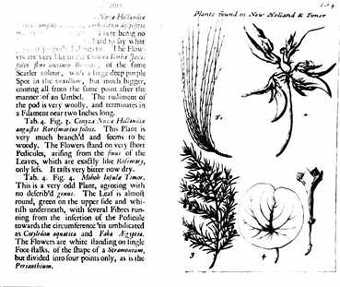
Dampier, Australia's first natural historian
There he collected many plants, shells and other specimens, and in full
and detailed descriptions of the plant and animal life encountered, he
was the first Englishman to do so. In also describing the landscape and
soils and in describing the land and marine animals, some in scientific
terms that are still in use today, Dampier deservedly earned himself the
title Alex George has afforded him—‘Australian’s first
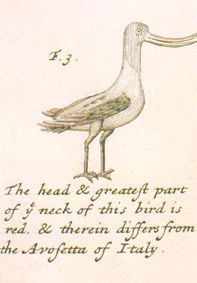
natural historian’. Dampier is not known to have been an artist,
however, and the charming drawings in his book entitled a ‘A Voyage
to New Holland’ are attributed to an unknown member of his crew,
a man Dampier himself describes in the preface to his work as a ‘Person
skill’d in Drawing’.
 top
top
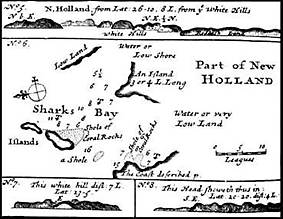
Of some importance to this narrative is Dampier’s comment that at
‘Sharks Bay’ (now Shark Bay), the shore was ‘was lined
thick with many sorts of very strange and beautiful Shells…I brought
away a great many of them…’. He also comments that further north,
in what is now known as the Dampier Archipelago, ‘… I gather’d
a few strange Shells, chiefly a sort not large, and thick-set all about
with Rays or Spikes growing in Rows’.
After calling in to Timor, Dampier sailed around the northern part of
New Guinea, naming Nova Britannia (New Britain). Dampier Strait was subsequently
named after him. Concerned at the state of his ship, at the end of March
1700, Dampier abandoned his plan to sail south to explore the eastern
Australian coast, leaving these explorations to Lt James Cook RN well
over half a century later. His reasons for doing so are evident in the
following quote and here also appears the seed of his coming misfortune.
'In the Afternoon I sent
my Boat ashore to the Island, to see what convenience there was to haul
our Vessel ashore in order to be mended…but we could not land. .I
design’d to have stay’d among these Islands till I had got my
pinnace refitted; but having no more than one Man who had skill to work
upon her, I saw she would be a long Time in repairing; (which was one
great Reason why I could not prosecute my discoveries further:)…'
Intending to touch again at New Holland (the west coast) in 20° latitude,
he found himself too far west and then headed off in search of the elusive
‘Tryal Rocks’ scene of the loss of the English East India Company
ship Tryal in 1622, the first known European ship lost on the Australian
coast. Being sick and unable to continue, Dampier then elected to head
for the nearest port Batavia, on west Java.
 Batavia
- top
Batavia
- top
This vibrant entrepot
was the headquarters of the Dutch East India Company (VOC) and the centre
of a vast trading network with links to China, Japan, India and Europe
generally. A vast array of goods, including ceramics passed through this
centre. Again this is of particular significance to this narrative.
Arriving at the end of June, Dampier then set about the repair of his
vessel and again the cause of his change of plans and the reasons for
the imminent demise of his ailing vessel at the hands of what appears
to be and inept ship’s carpenter emerge.
'…
I supplied the Carpenter with such Stores as were necessary for refitting
the Ship; which prov’d more leaky after he had caulk’d Her then
she was before: So that I was obliged to carreen her, for which purpose
I hired Vessels to take our guns, Ballast, Provision and Stores'
Back to main Dampier menu
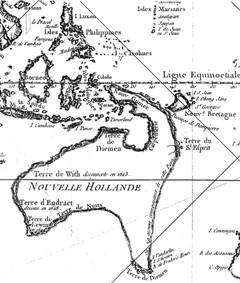
A French view of New Holland c.1750.
Note 'Dampier Passage', showing how close Dampier
go to his goal: the exploration of the east coast.
The loss of the Roebuck
On 17 October 1700 they left Batavia, arriving back at the Cape of Good
Hope (another VOC centre) at the end of December, and departed thence
on 11 January. On 2 February they anchored at St Helena till the 13th
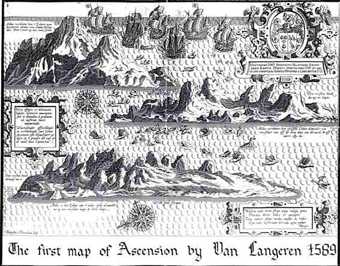
and then proceeded to Ascension Island, which they sighted on 21 February
1701.
 top
top
Dampier’s account of the ensuing events reads thus:
An account of the loss of His Majesty’s Ship Roebuck Febry 21st 1700/1.
At three aclock in the afternoon being in Sight
of the Island Ascension, and not having Light enough to carry us into
the Bay where design’d to anchor, …we stood to the Eastward,
At half an hour after 8 in the night we sprung a Leake on the larboard
bow about four Strakes from the Keele, which oblig’d us to keep our
Chain pump constantly going, at twelve at night having a moderate gale,
we bore away for the Island and be daylight were close in with it, at
nine aclock in the morning anchored in the N.W. bay in ten fathom and
half water, sandy ground about half a mile from the shoare, the S. point
of the bay bore S.S.W. dist. one mile and a half and the northernmost
point, N.E.1/2 N.dist. two mile……
John
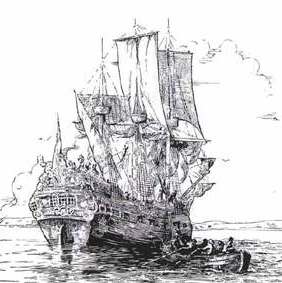
Alcott's impression of HM Ship Roebuck at Shark Bay
top
Being come to anchor I ordered the Gunner to
clear his Powder roome, that we might there search for the Leake, and
endeavour to stop it within board if possible, for we could not heele
the Ship so low, neither was there any convenient place to haul her ashoare….
I ordered the Carpenter’s Mate…with the Boatswain and some others
to goe downe and search for the Leake, the Carpenter’s Mate and the
Boatswain told me that they could not come at it unless they cut the Ceiling,
which I bid them doe, which done they found the Leake against one of the
foothook timbers, it was very large, and the water gushed in with great
violence… after the cutt the timber… the leake so increased…
I ordered a bulkhead to be cutt open to give passage to the water, and
withall ordered to cleare away abaft the bulkhead, that we might beale…But
about 11 aclock at night the Boatswain came to me, told me… that
the Plank was quite rotten, and that it was now impossible to save the
Ship…I therefore hoysted out the boate, and next morning, being the
23rd, we weigh’d anchor and warped in nearer the shoare, but to little
purpose till in the afternoon we had a Sea breeze by which we gott in
within a Cable’s length of the Shoare, then made a Raft to carry
men’s chests and bedding ashoare., and before Eight at night most
of them were gott ashoare, She struck not before nine aclock at night,
and so continued, I ordered some sailes to be cut from the yards
to make us some tents, etc, and the next morning being the 24th myself
and Officers went ashoare…
Additional information and details of events significant to the loss of
the ship appeared in Dampier’s published account entitled A Voyage
to New Holland that appeared a few years later, in 1703:
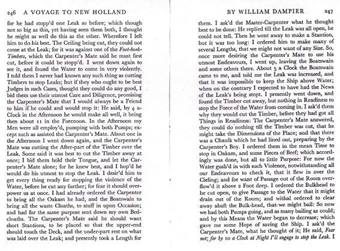
…In
the Afternoon, with the help of a Sea-breeze, I ran into 7 Fathom, and
anchored; Then carried a small Anchor ashore, and warp’d in till
I came into 3 Fathom and a half. Where having fastnd her, I made a Raft….
On the 26th following, we, to our great Comfort, found a Spring of
fresh water, about 8 Miles from our Tents, beyond a very high Mountain,
which we must pass over: So that now we were, by God’s Providence,
in a Condition of subsisting some Time; having Plenty of very good Turtle
by our Tents….The next Day I went up to see the Watering-place…where
we found a very fine Spring on the South-East-side of the high mountain,
about half a Mile from its top:…About 2 Mile South-East from the
Spring, we found 3 or 4 shrubby Trees, upon which was cut an Anchor and
Cable, and the year 1642….
[on 3 April] …appear’d 4 Sail, which came to anchor in this
Bay. They were his Majesty’s Ships, the Anglesey, Hastings and Lizard;
and the Cantebury East-India Ship. I went on board the Anglesey with about
35 of my Men; and the rest were dispos’d of into the other Men of
War.
We sail’d from Ascension, the 8th…
From:
William Dampier’s unpublished account of the loss of the “Roebuck.”
(Public Record Office, Admiralty 1/5262) Dated; 29 September, 1701
Go to Wreck Searches